
Gisela Peters · 14 October 2026
How Emerging Online Retailers Apply Machine Learning to Forecast Demand Spikes During Peak Shopping Periods
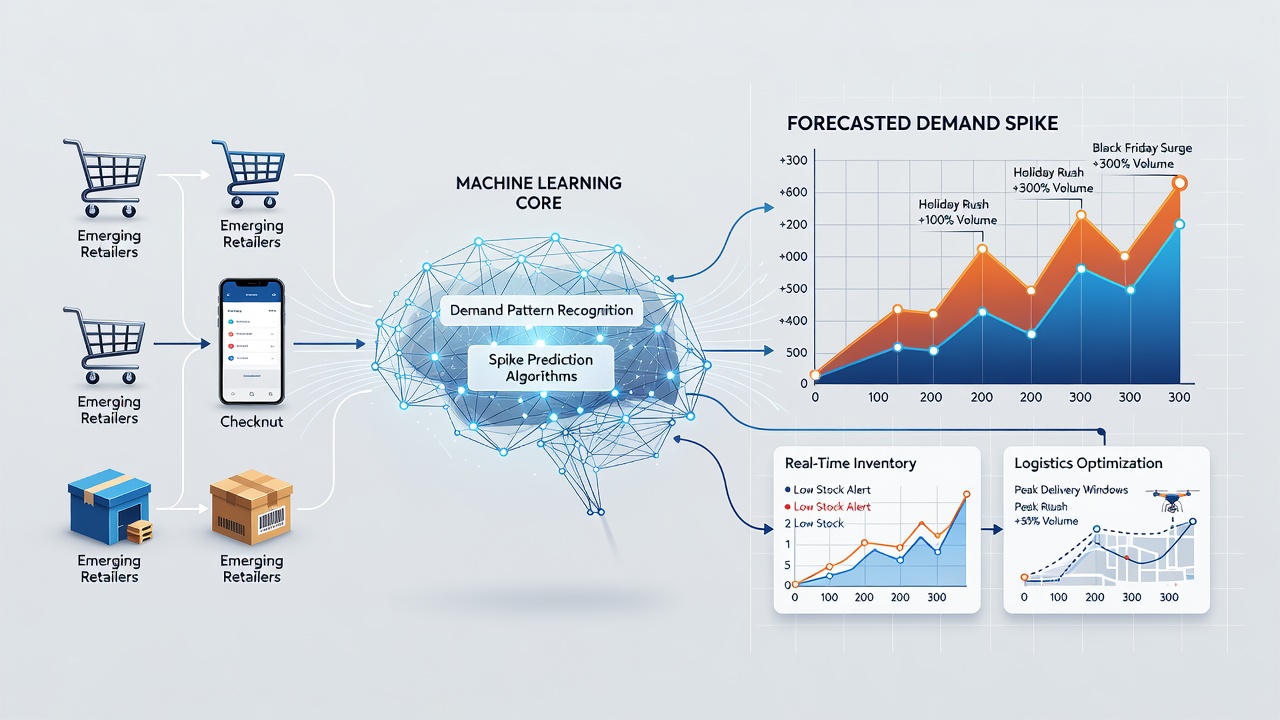
Emerging online retailers rely on machine learning models to predict sudden increases in customer orders during high-traffic periods such as holiday seasons and promotional events, and these systems process vast amounts of historical sales data alongside real-time signals from web traffic and external factors. Data shows that accurate forecasts help these businesses maintain inventory levels without overstocking or facing shortages, while algorithms trained on past patterns adjust predictions as new information arrives throughout the sales cycle.
Core Machine Learning Techniques in Demand Prediction
Supervised learning models form the backbone of many forecasting systems where retailers feed labeled datasets of previous sales spikes into neural networks and gradient boosting frameworks, and these tools identify correlations between variables like search volume spikes and purchase rates. Time series analysis through recurrent neural networks captures seasonal trends and sudden shifts, whereas ensemble methods combine outputs from multiple algorithms to reduce errors in volatile periods. Researchers at various institutions have documented how these approaches improve accuracy when retailers incorporate weather data, social media trends, and economic indicators into training sets.
Reinforcement learning adds another layer by allowing models to refine strategies based on feedback from actual sales outcomes, and this method proves useful when market conditions change rapidly during events like flash sales. Observers note that emerging retailers often start with simpler regression models before scaling to deep learning architectures as their data volumes grow, and this progression allows smaller teams to achieve reliable results without extensive infrastructure investments.
Data Sources and Integration Methods
Retailers aggregate internal records from transaction logs and customer browsing histories with external datasets from government statistical agencies, and integration happens through APIs that feed cleaned information into centralized platforms. According to figures from the U.S. Census Bureau, retail sales data provides baseline benchmarks that models use to calibrate predictions for similar product categories. Additional inputs include mobile app usage metrics and email campaign open rates, which help refine estimates for individual customer segments during peak windows.
October 2026 marks an anticipated surge in online activity ahead of major holiday promotions, and systems prepare by running simulations on historical October patterns to anticipate volume increases. Those who manage these platforms often combine structured data from enterprise resource systems with unstructured text from customer reviews, and natural language processing extracts sentiment signals that influence demand projections for specific items.
Handling Peak Period Challenges
Peak shopping periods introduce noise from promotional campaigns and competitor actions, yet machine learning systems counter this by applying anomaly detection to separate genuine demand shifts from temporary fluctuations. Models trained on multi-year datasets account for events such as back-to-school rushes or end-of-year clearances, and they update weights dynamically as live sales data streams in during the event itself. Emerging retailers report that hybrid approaches blending machine learning with rule-based thresholds deliver faster responses when sudden spikes exceed expected ranges.
Geographic variations require localized models, and data from the Australian Bureau of Statistics on retail turnover helps calibrate forecasts for markets with distinct seasonal behaviors. Teams address latency issues by deploying edge computing solutions that process predictions closer to data sources, while cloud-based training handles the heavier computational loads required for model updates between peak events.
Implementation Examples Across Retail Segments
One apparel retailer integrated machine learning pipelines that combined point-of-sale records with social media engagement metrics, and the resulting forecasts reduced stockouts during major sales events by aligning replenishment schedules more closely with predicted volumes. Another example involves a consumer electronics seller that used clustering algorithms to group products by demand elasticity, allowing differentiated forecasting strategies for high-turnover items versus niche accessories. These cases illustrate how smaller platforms adapt established techniques to their specific inventory constraints and customer bases.
Studies from academic sources indicate that continuous model retraining on fresh data improves performance over static systems, and this practice becomes especially relevant when external shocks like supply chain disruptions coincide with peak demand windows. Retailers monitor key performance indicators such as mean absolute percentage error to evaluate model effectiveness, and they adjust feature sets when certain signals lose predictive power over time.
Conclusion
Machine learning enables emerging online retailers to anticipate demand spikes through systematic analysis of diverse data streams and iterative model refinement, and this capability supports operational decisions around inventory and marketing during critical periods. Continued advances in algorithm design and data availability point toward broader adoption as these tools become more accessible to growing businesses.